Every year, dengue virus infects up to
400 million
people worldwide.
For most, a first infection resolves. But a second infection with a different serotype can be life-threatening.
The reason? Your own antibodies.
The antibody paradox
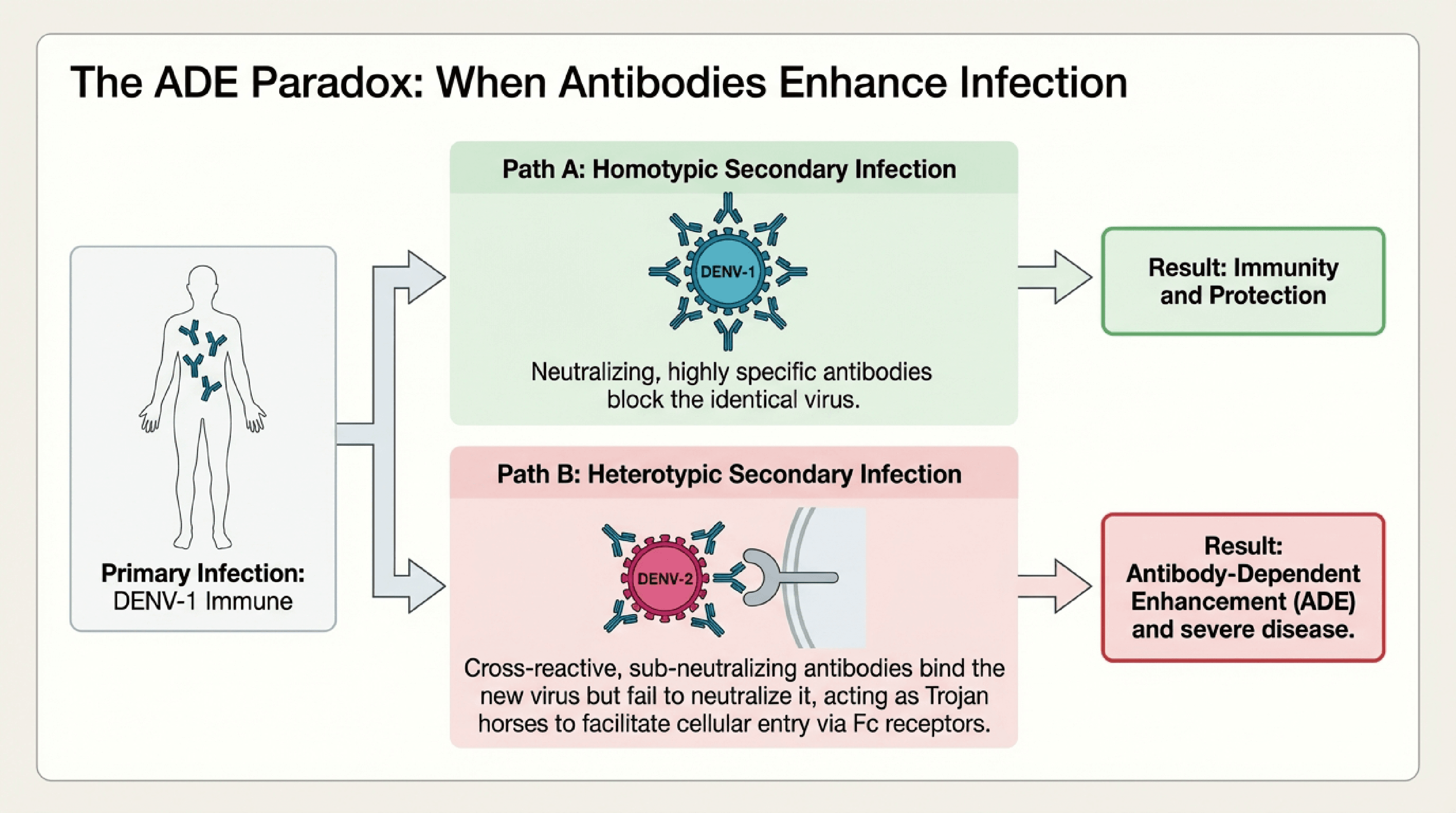
Dengue has four serotypes. After a first infection, B cells produce antibodies. Some are type-specific, neutralizing only the original serotype. Others are cross-reactive, binding other serotypes but weakly. Those weakly cross-reactive antibodies do not neutralize. Instead, they can facilitate viral entry into cells via Fc receptors. This is antibody-dependent enhancement.
The question
For each individual B cell, which dengue serotypes do its secreted antibodies recognize?
Is a given B cell type-specific (binding one serotype) or cross-reactive (binding multiple)? And across a patient's entire B cell repertoire, what is the ratio? In 2015, no method could map this at single-cell resolution with sufficient throughput.
The gap
Existing tools lacked the required resolution
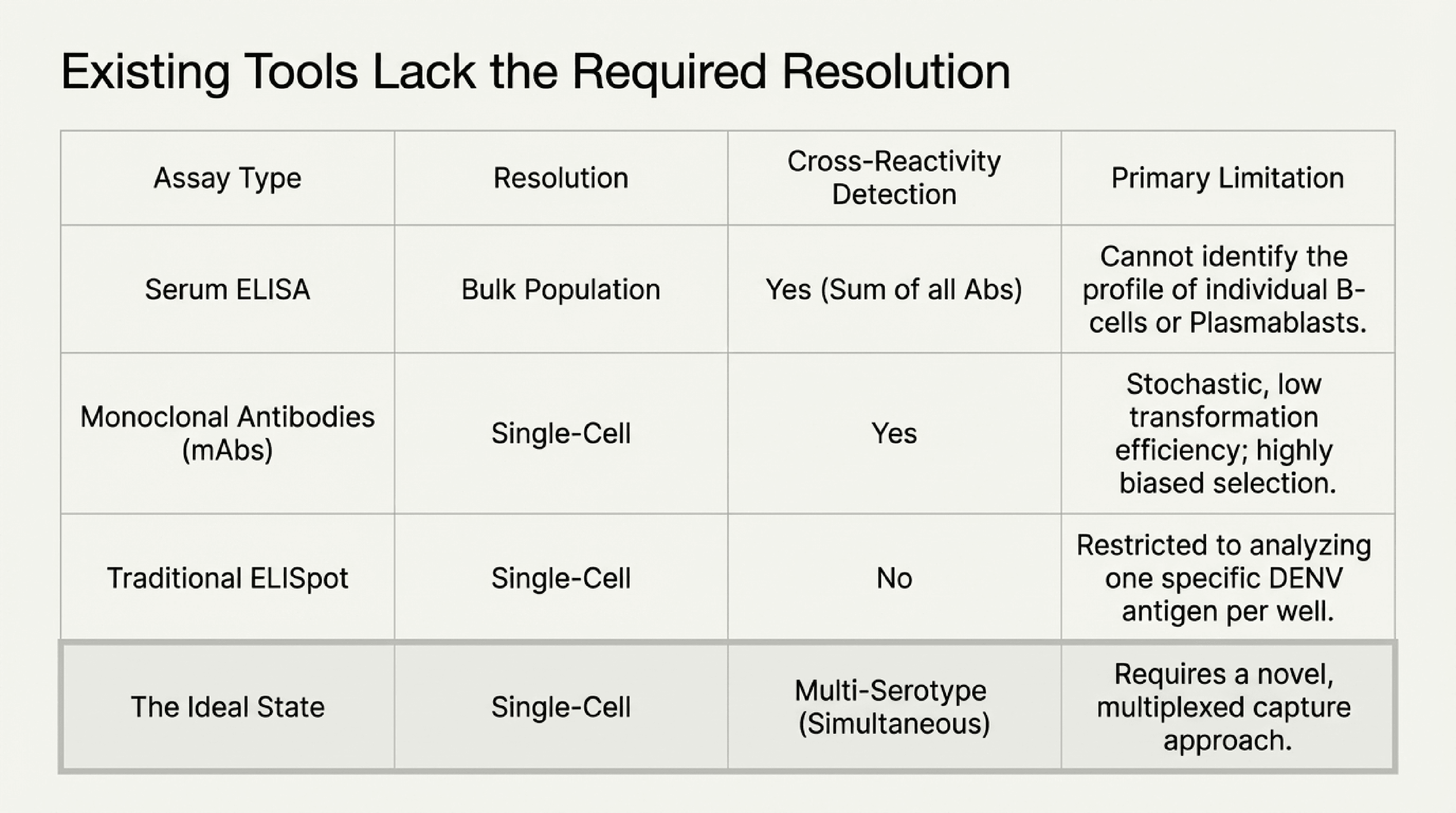
What was needed: single-cell resolution, multi-serotype detection, and high throughput. All at once.
The solution
The Quad-Color FluoroSpot
A visual walkthrough of how we re-engineered the B-cell assay to map serotype specificity and cross-reactivity at single-cell resolution.
The architectural shift
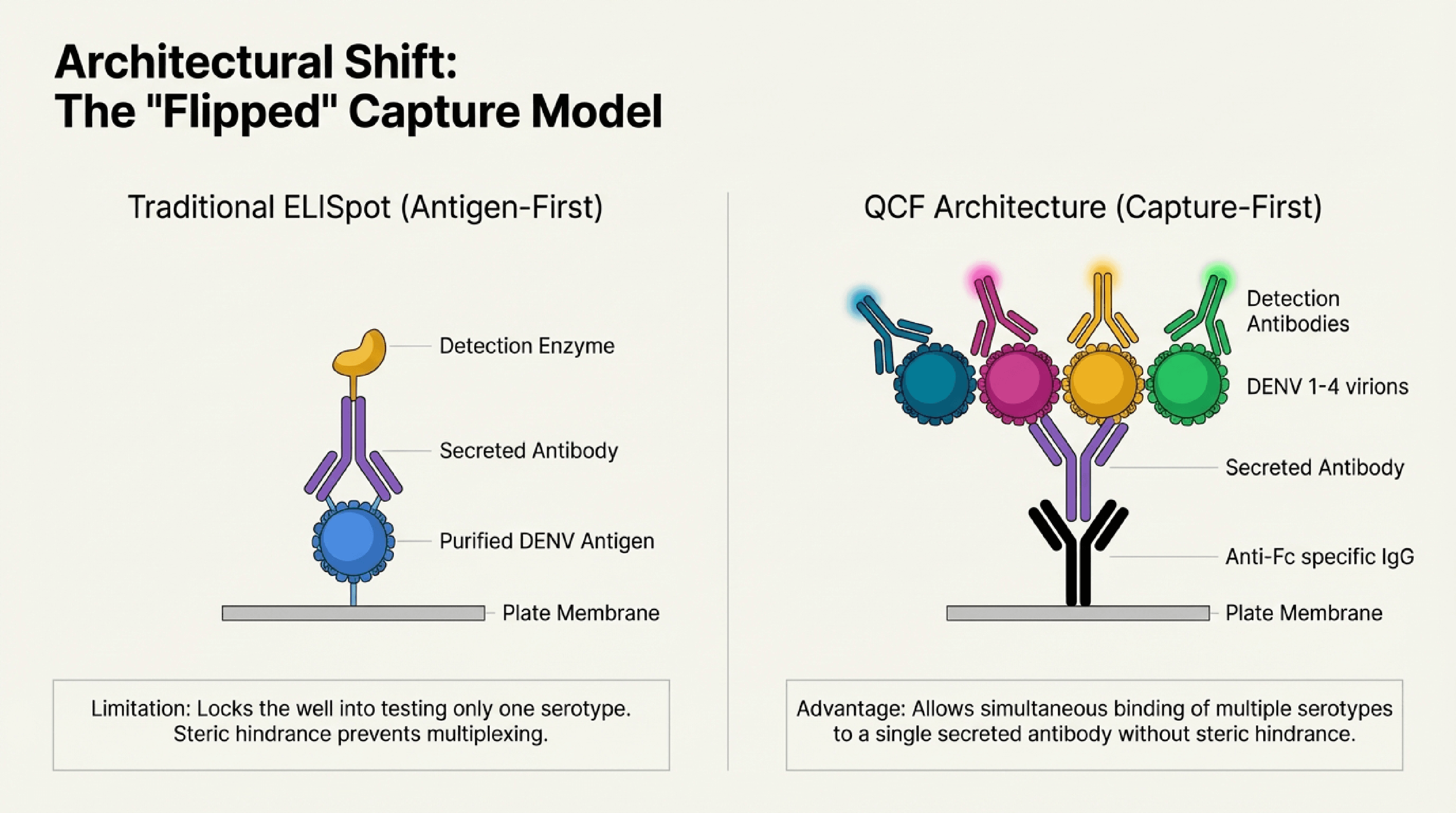
Decouple capture from detection
The conventional ELISPOT coats the plate with antigen, locking each well into one serotype. We replaced the antigen coating with an anti-Fc capture antibody that grabs any secreted antibody regardless of specificity. This freed the detection step for multiplexing: four serotypes, four fluorophores, one well.
The readout
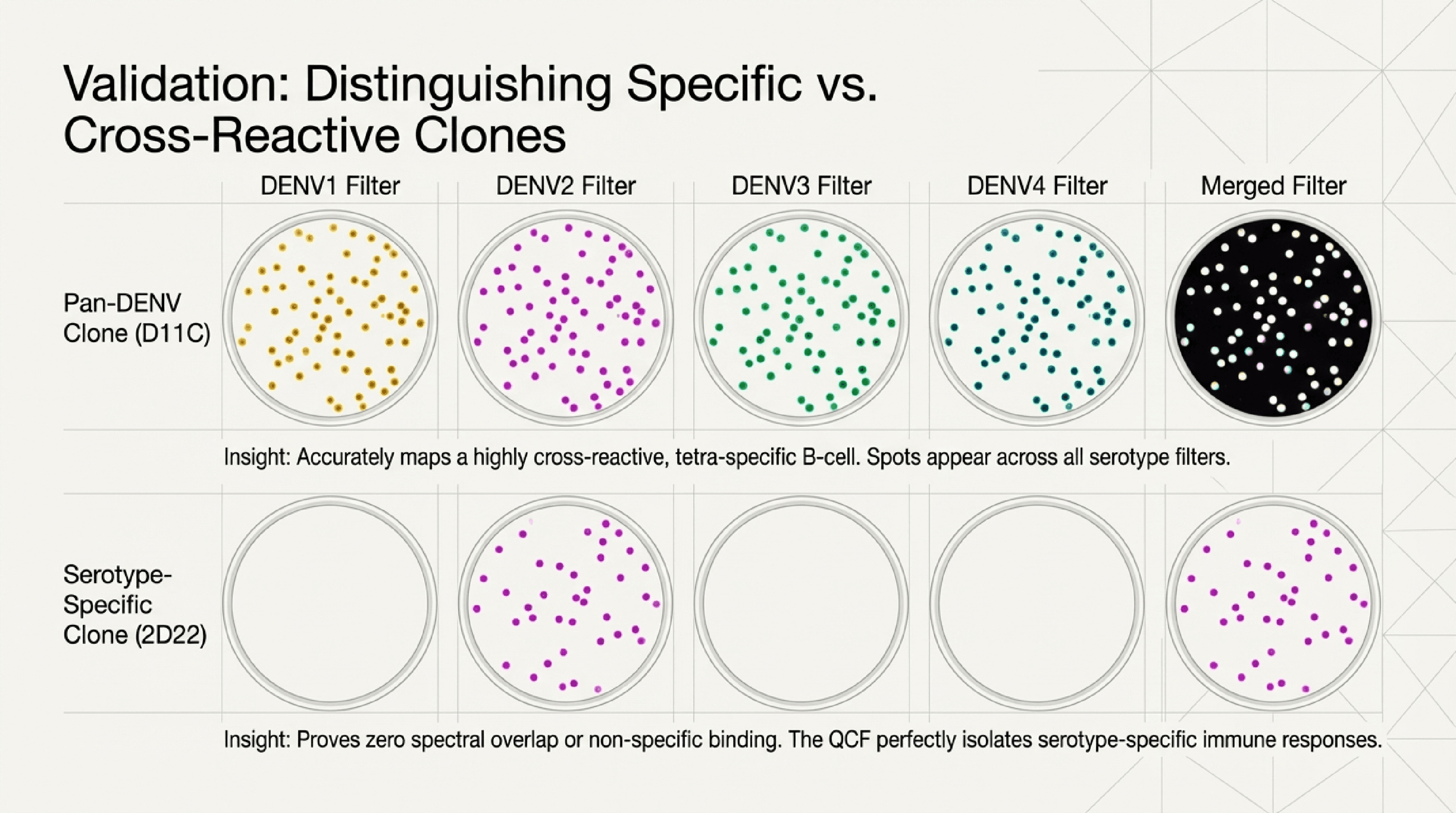
One spot, one B cell, four colors
Each spot's color composition directly reveals which serotypes the originating B cell's antibodies recognize.
Clinical translation
Mapping the shift in human immunity
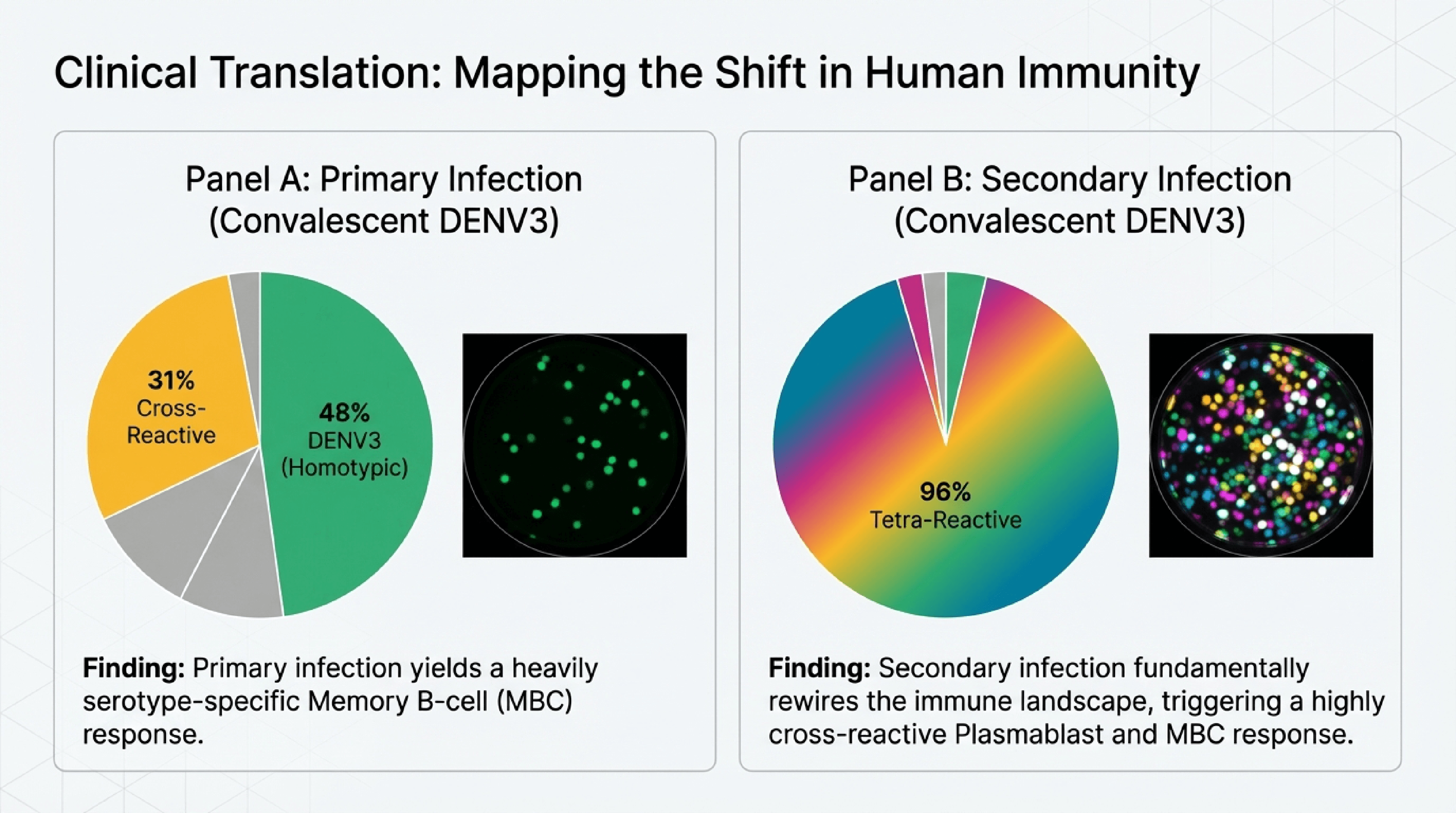
Applied to dengue patients, the QCF revealed a striking difference: after a primary infection, 48% of memory B cells were type-specific (homotypic). After a secondary infection with a different serotype, 96% were cross-reactive (tetra-reactive). The immune landscape fundamentally shifts.
Then and now
How the field has evolved
Since 2015, powerful new technologies have emerged for profiling B cell specificity. Each brings different strengths and different trade-offs.
LIBRA-seq
Linking BCR to antigen specificity through sequencing
DNA-barcoded antigens bind B cells, which are then sorted and sequenced. Reveals both the BCR sequence and antigen specificity. Powerful for antibody discovery, but requires specialized equipment, millions of cells, and extensive bioinformatics.
Antigen-barcoded scRNA-seq
CITE-seq with tagged antigens
Oligonucleotide-tagged antigens combined with single-cell RNA sequencing. Full transcriptome plus specificity per cell. Exceptional depth, but high cost per cell, complex library preparation, and limited throughput for large cohort studies.
Spectral flow + antigen probes
Fluorescent antigen tetramers for B cell sorting
Labeled antigen probes identify B cells by surface BCR binding. Enables sorting for downstream sequencing. However, this measures surface receptor binding, not what the cell actually secretes, which may differ after affinity maturation.
What the QCF still uniquely provides
Measures what B cells actually secrete, the effector molecule, not surface BCR binding. After affinity maturation, secreted antibody specificity can differ from the surface receptor.
No flow cytometer, no sequencer, no bioinformatics pipeline. A filter plate, a fluorescence reader, and results in 24 to 48 hours. Deployable in endemic-country labs.
Orders of magnitude cheaper per sample than scRNA-seq. Can profile thousands of patients in vaccine trials where per-sample cost is a hard constraint.
The multi-color overlay directly reveals how many and which serotypes a single B cell's secreted antibodies bind. No computational deconvolution needed.
Modern sequencing-based approaches and the QCF are complementary, not competing. Sequencing reveals mechanism and receptor identity. The QCF reveals functional output at population scale. Together they map the full landscape of B cell immunity.
Looking ahead
Beyond dengue
The capture-first architecture is not limited to dengue. Any pathogen with multiple serotypes, subtypes, or variants poses the same question: which B cells cross-react, and how broadly?
The approach has been extended to dengue/Zika cross-reactivity and allelic cross-reactivity profiling of monoclonal antibodies. The flexible capture-first design adapts wherever mapping B-cell specificity at single-cell resolution matters, especially in resource-limited settings where sequencing infrastructure is unavailable.